Cash Flow Is the Lifeblood of Financial Sovereignty
Cash Flow Management, Financial Sovereignty, Legacy Planning
Cash Flow Is the Lifeblood of Financial Sovereignty
Why do so many smart, high-earning professionals still feel like their money is quietly slipping through their fingers? The answer is almost always the same: they focus on income, investments, and net worth but overlook the quiet, unglamorous force that actually keeps their financial life alive and sovereign: cash flow.
Income vs. Cash Flow: The Difference Most People Never See
On paper, income looks impressive. It’s the salary number on a job offer, the revenue line on a business report, the rental checks hitting your account each month. Income is what you earn. Cash flow is what you actually keep, direct, and deploy after money moves through your life, your business, and your obligations.
Think of income as water entering a property through a main pipe. Cash flow is the water that remains available after it has moved through sinks, showers, sprinklers, and hidden leaks. You can have a strong water line and still end up with dry faucets if the system is poorly designed. The same is true with money: a high income without intentional cash flow design often leads to constant pressure and very little freedom.
At BDE Wealth, we view cash flow as a system, not a spreadsheet line. It reflects how money enters, moves through, and exits your life. It reveals your priorities, your habits, and your structures. It exposes whether you are living as a financial consumer or a financial steward. Income is a snapshot. Cash flow is a story.
💬 Original Insight: “Income tells the world how valuable your time is. Cash flow tells you how intentional your decisions are.”
Reflect for a moment: If your income stopped for three months, how long would your current cash flow system sustain your life, your business, and your commitments? That answer reveals more about your sovereignty than any salary figure ever could.
Why High-Income Earners Still Feel Financial Stress
Many professionals quietly carry a confusing tension: their income is higher than ever, yet peace of mind hasn’t followed. The numbers say they are “doing well,” but their lived experience feels tight, rushed, and fragile. This isn’t a character flaw; it’s a systems issue rooted in how cash flow is designed (or not designed) around their life.
Consider Jordan, a mid-career executive earning multiple six figures. On social media, Jordan looks financially successful: luxury travel, a beautiful home, impressive titles. Underneath, the reality is more complex: high fixed expenses, debt payments, private school tuition, and lifestyle commitments that quietly consume nearly every dollar that comes in. Jordan doesn’t have an income problem. Jordan has a cash flow structure problem, one built on assumptions, habits, and unexamined expectations rather than intentional design.
High-income stress usually comes from three sources:
Escalating fixed commitments that grow as income grows, such as housing, vehicles, subscriptions, and activities, reduce flexibility and margin.
Lack of visibility into where money truly goes each month, especially as life becomes more complex with children, businesses, or multiple properties.
No intentional cash flow plan that connects today’s decisions with long-term sovereignty, taxes, and legacy.
Story Lesson: When a couple we’ll call Maya and Luis finally mapped their cash flow, they discovered that nearly 40% of their monthly income was going toward obligations they no longer valued: unused memberships, overscheduled activities, and debt from past lifestyle choices. Their stress wasn’t about “not earning enough.” It was about funding a life they no longer intentionally chose.
Ask yourself: If your income increased by 20% next year, would your cash flow actually create more freedom, or would your lifestyle automatically expand to meet it? That question reveals whether you are using income to buy options or to buy obligations.
Cash Flow vs. Net Worth: The Illusion of “On Paper” Wealth
Net worth is often treated as the ultimate financial scorecard: assets minus liabilities. While it certainly matters, it doesn't tell the whole story. A person can have substantial wealth tied up in illiquid assets such as real estate, privately owned businesses, or retirement accounts and still feel financially stressed because their monthly cash flow is weak or even negative.
Imagine two families:
Family A has a $3 million net worth, mostly in a primary home, retirement accounts, and a business interest. Their monthly cash flow is tight, dependent on a single income, with little margin for disruption.
Family B has a $1 million net worth with multiple, modest income streams—some from a small business, some from rentals, some from conservative investments. Their monthly cash flow covers their lifestyle with a healthy margin and reserves.
On paper, Family A is “wealthier.” In practice, Family B is more sovereign. They can absorb shocks, make choices, and pivot without selling assets in a panic or taking on new debt. Net worth is a snapshot of accumulated resources. Cash flow is your ability to use those resources without eroding your future.

Clear cash flow visibility often brings more peace than a higher net worth number.
A core BDE Wealth principle is this: Net worth without healthy cash flow can create impressive balance sheets and fragile lives. When you understand cash flow, you stop chasing only accumulation and start designing for stability, flexibility, and impact.
Cash Flow and Stewardship: What Your Money Says About Your Priorities
Stewardship is not about deprivation; it’s about responsibility and alignment. It asks, “Am I directing resources in a way that reflects my values, responsibilities, and long-term vision?” Cash flow is the clearest mirror of your stewardship because it shows, line by line, where your priorities truly live, not just where you wish they did.
An intentionally designed cash flow system doesn’t just track spending; it assigns purpose to every dollar. Some dollars are assigned to today’s needs, some to future resilience, some to opportunity, some to generosity. When you view money as a resource you are responsible for, rather than something you simply consume, your relationship with cash flow changes from “What can I afford?” to “What am I building?”
Reflective Question: If someone could only see your cash flow, no social media, no titles, no house, what would they conclude matters most to you?
Stewardship-oriented cash flow is not about perfection; it’s about progress and clarity. When you know where your money is going and why, you can adjust with intention instead of reacting with guilt or confusion. You move from drifting to directing.
Cash Flow and Intentional Decision-Making: Creating a Personal Financial Operating System
Most financial stress doesn’t come from a single bad decision; it comes from a series of unexamined decisions made without a clear operating system. Cash flow is where those decisions accumulate. Every subscription, every loan, every “just this once” purchase quietly joins your monthly system and either supports or strains your sovereignty.
At BDE Wealth, we encourage people to think of cash flow as their personal financial operating system. Before you say “yes” to a new commitment, ask:
How does this decision change my monthly cash flow today and one year from now?
Does this obligation buy me flexibility, or does it reduce it?
What future options am I trading for this present choice?
Intentional decision-making doesn’t mean upgrading your life or investing in what you enjoy. It means understanding the system impact of your choices. When your cash flow is structured, you can say yes or no from a place of clarity instead of emotion or pressure. That is the beginning of financial sovereignty: the ability to choose with eyes open.
Original Analogy: Cash flow is like the calendar for your money. You wouldn’t accept every meeting request without checking your schedule. Treat new financial commitments the same way.
Cash Flow in Business Ownership: The Oxygen of Your Enterprise
For business owners and entrepreneurs, cash flow is not just important—it’s existential. Revenue can be high; profits can look strong on paper, but if cash isn’t available when payroll, vendors, and taxes are due, the business suffocates. Many promising companies fail not because their idea is weak, but because their cash flow system is fragile or reactive.
Consider a small real estate investment company. Deals close, properties appreciate, and equity grows. Yet if rent collection is inconsistent, repairs are not planned for, tax obligations are ignored until the last minute, and reserves are thin, one unexpected vacancy or major repair can create a cascade of stress. The business may still “look good” on a balance sheet while the owner is losing sleep over next month’s obligations.
Healthy business cash flow systems:
Separate business and personal finances clearly, so the owner can see reality in both domains.
Allocate income into operating expenses, taxes, reserves, owner compensation, and reinvestment on purpose, not by accident.
Build in buffers for seasonality, delays, and unexpected costs so the business can breathe during turbulence.
Business Reflection: If your business had no new revenue for 90 days, what would your cash flow system allow you to sustain? That answer reveals how much sovereignty your business truly has.
When business owners master cash flow, they stop building companies that own them and start building companies that support their life, their family, and their long-term legacy design.
Cash Flow and Family Finances: Turning Money Into a Shared Language
In families, cash flow is more than math; it’s communication. It reveals how decisions are made, how responsibilities are shared, and how values are lived out in real time. When cash flow is chaotic, conversations often become reactive, emotional, or avoided. When cash flow is structured, families gain a shared language for planning, prioritizing, and preparing together.
Picture a family that meets once a month for a short “family finance huddle.” They review what came in, what went out, and what they are building toward. Older children might see how part of the cash flow supports education savings, giving, or a future family trip. Instead of money being a source of tension, it becomes a tool for teamwork and stewardship. This is family governance at a practical level, and it starts with simple, visible cash flow systems.
Family Question: What would change if your family treated cash flow conversations not as “budget talks” but as “legacy design sessions”?
When families see cash flow as part of their shared story, children learn that money is not just for spending; it’s for building, protecting, and serving. That mindset is a powerful gift to pass forward.
Building Financial Resilience: Cash Flow as Your First Line of Defense
Resilience is the ability to absorb shocks without losing your footing. In financial terms, resilience is less about predicting the future and more about designing systems that can adapt when the unexpected arrives: job changes, health events, market downturns, business disruptions, or family needs. Cash flow is your first line of defense in all of these scenarios.
A resilient cash flow system typically includes:
Thoughtfully sized emergency reserves based on your actual obligations and risk profile, not arbitrary rules of thumb.
Margin space between what comes in and what goes out so adjustments can be made without panic when life shifts.
Diversified income sources where appropriate, so no single point of failure can destabilize the entire system.
One of the most powerful questions you can ask is: “If something went wrong, how would money move?” Walking through that scenario forces you to see whether your current cash flow would bend or break under pressure. Resilient systems are rarely accidental; they are the result of intentional design and ongoing adjustments as life evolves.
Key Takeaway: Resilience is not just having savings. It has a cash flow structure that knows what to do when savings are needed.
Long-Term Financial Sovereignty: Designing Systems, Not Shortcuts
Financial sovereignty is the ability to make decisions based on values and vision rather than fear or external pressure. It’s not about never working again; it’s about having the structures, knowledge, and options to direct your life with intention. Cash flow is the day-to-day expression of that sovereignty. Without it, even impressive assets can feel like cages instead of tools.
Many people look for shortcuts to sovereignty: a single investment, a sudden windfall, a “perfect” strategy. At BDE Wealth, we focus instead on systems over shortcuts. Systems you understand. Systems you can explain to your family. Systems that are flexible enough to evolve as your life, tax laws, and opportunities change. Cash flow is where those systems live and breathe each month.
Ask yourself:
Do I have a clear, written structure for how income flows through my life, my businesses, and my obligations?
Could my spouse, partner, or trusted family member understand and operate this system if I were unavailable?
Does my current cash flow support the life I say I want to live ten years from now, or is it quietly pulling me in a different direction?
Sovereignty is built in layers: awareness, structure, discipline, and adaptability. Cash flow is the thread that connects them all. When it is designed intentionally, you don’t just have money; you have direction.
Cash Flow as Part of Legacy Planning: What Continues When You Don’t
Legacy planning often focuses on documents, assets, and distributions. Those matter. But true legacy is not just about what you leave; it’s about what continues to function, grow, and serve after you are no longer the one directing it. That continuity is, again, a cash flow question: How will money move after you are gone? Who understands the system? What values will guide decisions when you are no longer the primary decision-maker?
Imagine two scenarios. In the first, a family receives assets but no context. They inherit accounts, properties, perhaps a business interest, but no clear understanding of how cash flows in and out, what risks exist, or what the original owner intended. Confusion often leads to conflict, reactive decisions, and, over time, erosion of both wealth and relationships.
In the second scenario, a family not only inherits assets but also receives a clear picture of the cash flow systems that support those assets: how income is generated, how expenses are managed, how taxes are planned for, how reserves are maintained, and what principles should guide future decisions. They don’t just receive wealth; they inherit a stewardship framework.
Legacy Reflection: If your heirs could only see your current cash flow system and not hear your voice, would they know how to steward what you’ve built?
Integrating cash flow into legacy planning means documenting not only “who gets what,” but also “how this works” and “why this structure exists.” It’s an act of care, clarity, and respect for the people who will carry your work forward.
Bringing It All Together: Designing Cash Flow for Sovereignty, Not Survival
When you step back, a pattern emerges. Cash flow touches every part of a sovereign financial life:
It reveals the difference between high income and true freedom.
It shows whether your net worth can actually support your lifestyle and responsibilities.
It reflects your stewardship, your priorities, and your decision-making habits.
It fuels your business, your family governance, your resilience, and your legacy.
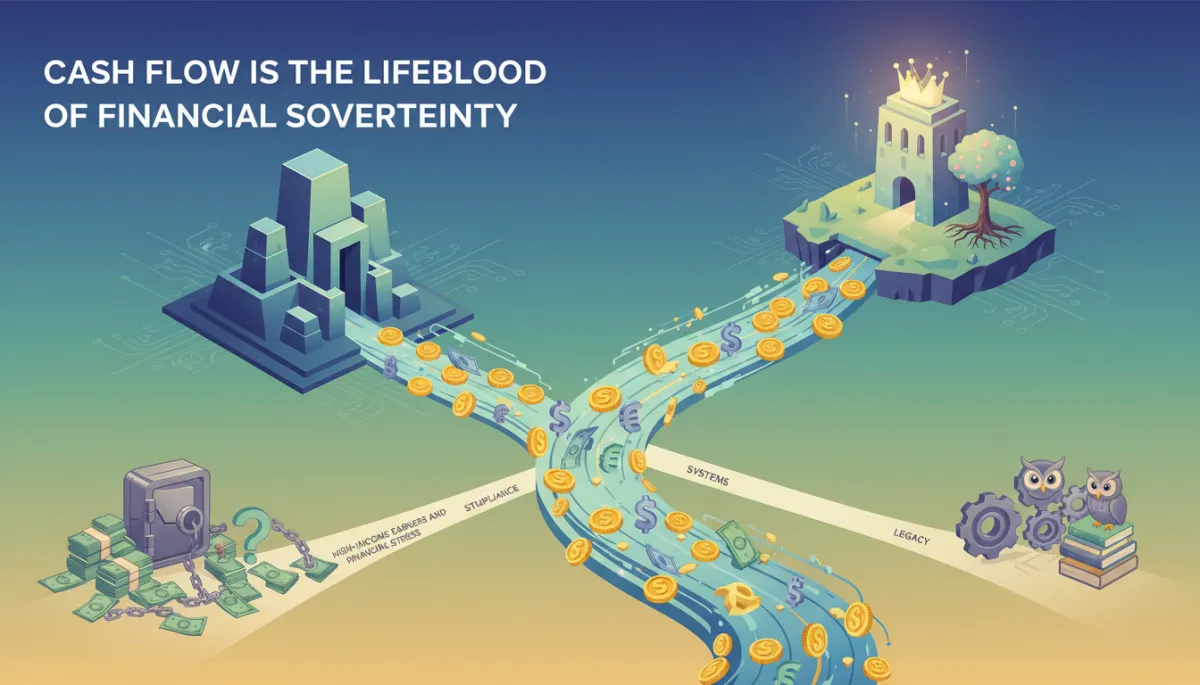
Cash flow is the lifeblood of financial sovereignty because it is the mechanism through which your values, structures, and goals become real each month. Without it, even the best intentions stay theoretical. With it, you gain the flexibility to adapt, the confidence to decide, and the capacity to build something that lasts beyond you.
Final Reflection Questions: What is your cash flow currently designed to do: maintain, survive, or build? And if you could redesign it from a blank slate, what would you want it to support over the next five, ten, and twenty years?
A Next Step: Becoming an Intentional Steward of Your Cash Flow
You don’t need to overhaul your entire financial life overnight to honor these ideas. You can begin with awareness: tracing where your money actually goes, noticing which commitments still serve you, and identifying where your current system supports or undermines your sovereignty. From there, you can gradually redesign how cash enters, moves through, and exits your life with stewardship, structure, and legacy in mind.
At BDE Wealth, we believe that wise financial decisions emerge from clarity, not pressure. If you are ready to explore how your current cash flow aligns with the life and legacy you want to build, consider scheduling a Legacy Fit Session™. It’s an opportunity to step back, examine your systems, and begin designing a cash flow structure that supports true financial sovereignty for you, your family, and the generations who may follow.
Whatever next step you choose, treat your cash flow as more than numbers on a page. See it as a living system that tells the story of your stewardship, your structure, and your intentional wealth design. That story is being written every month. You have the opportunity and the responsibility to shape it on purpose.