The Purpose of Wealth: Why Wisdom Matters More Than Money
Wealth, Stewardship, Legacy, Financial Education
The Purpose of Wealth: Why Wisdom Matters More Than Money
Wealth can buy comfort, options, and access. But without wisdom, it rarely creates peace, purpose, or a lasting legacy. At BDE Wealth, we believe the real question isn’t “How do I get more money?” but “What is money actually for in my life, my family, and my work?”
Why Wisdom Must Come Before Wealth
Money is a powerful tool, but it is also an amplifier. It magnifies what is already present in a person, a family, or a business. If there is clarity, character, and purpose, wealth tends to expand that. If there is confusion, conflict, or fear, wealth often accelerates the damage instead of solving it.
Think of money like electricity in a building. On its own, electricity doesn’t care what it powers. It can light a hospital, or it can overload faulty wiring and burn the same building down. The difference isn’t the voltage; it’s the design of the system and the wisdom of the people using it. Wealth works the same way. The “wiring” of your life, business, and family matters more than the size of the current running through it.
“More money doesn’t fix poor decisions. It multiplies their consequences.”
This is why, at BDE Wealth, we teach WHY before HOW. Before you ask, “Which investment should I choose?” we invite you to ask, “What is the purpose of this money in my life?” Before you ask, “How do I pay less tax?” we ask, “What kind of life, impact, and legacy are you actually trying to build?”
Reflective Questions
If your income suddenly doubled, what would actually change in your life—and what would stay the same?
Where do you feel the most financial pressure right now—and is it really about money, or about clarity and structure?
Practical Takeaway: Before you chase a new strategy or opportunity, write down a one-sentence purpose for your wealth: “Money is a tool to help me …” Fill in that blank for your life, your family, and your business.
Stewardship Before Accumulation: You Don’t Own It, You’re Responsible for It
One of the most common assumptions in modern culture is that wealth equals ownership and control. “My money. My business. My assets.” But history tells a different story. Empires rise and fall. Currencies change. Businesses are bought, sold, or disrupted. Even family fortunes shift hands within a generation or two. If we’re honest, we don’t truly own wealth. We steward it for a period of time.
Imagine you’re handed the keys to a classic car that’s been in your family for 60 years. You can drive it, maintain it, improve it, or neglect it. You can even decide who gets it next. But you didn’t build it from raw metal, and you can’t take it with you when you’re gone. Your role is stewardship, not permanent ownership. Wealth is similar: a responsibility, not just a reward.
At BDE Wealth, stewardship means asking, “What has been entrusted to me, and how can I manage it with wisdom, integrity, and intention?” That includes money, of course, but also time, relationships, skills, and opportunities. When you see yourself as a steward, accumulation stops being the goal. Alignment does. You begin to measure success not only by what you have, but by how faithfully you manage what you’ve been given.
A Relatable Family Story of Stewardship
Consider a family where the grandparents built a small but successful real estate portfolio. They lived simply, paid off debt, and slowly accumulated a few rental properties. Their children grew up watching the effort but not always understanding the principles. When the grandparents passed, the portfolio transferred to the next generation with minimal instructions just assets, no roadmap.
One sibling saw the properties as a responsibility to honor. They studied the leases, talked with the tenants, and met with advisors to understand the tax and legal implications. The other sibling saw the properties as a quick exit. “Let’s just sell everything and split the cash.” Same assets, different lens. Over time, one sibling expanded the portfolio and eventually passed a stronger foundation to their children. The other spent the proceeds within a few years and returned to financial anxiety. The difference wasn’t luck. It was stewardship.
“Stewardship before accumulation: manage well what you have before you multiply it.”
Reflective Questions
Where in your finances do you feel like a true steward—and where do you feel more like a passive owner or even a bystander?
If your children or successors watched how you handle money, what silent lessons would they be learning?
Practical Takeaway: Make a simple “stewardship inventory.” List your key resources: income, assets, relationships, skills, and write one concrete step you can take this month to manage each of them with more intention.
Structure Before Strategy: The Hidden Architecture of Financial Sovereignty
Another common assumption is that the right strategy an investment, a tax move, a “hot” opportunity- will fix everything. But in our experience, the people who feel the most overwhelmed aren’t missing a strategy. They’re missing a structure. They’re stacking tactics on top of a shaky foundation, then wondering why everything feels fragile.
Picture a skyscraper. The higher you build, the less visible the foundation becomes. From the street, you see glass, steel, and lights. What you don’t see is the deep, engineered structure below ground that makes the height possible. In wealth-building, most people obsess over the “glass and steel” of their investments, their income, their latest deal while ignoring the foundation: the legal structures, risk protections, cash-flow systems, and governance that hold everything up.
Financial sovereignty is not just about having more money. It’s about having the right structures so that money serves your values, your family, and your long-term plans without being constantly at the mercy of emergencies, lawsuits, tax surprises, or family conflict. Sovereignty means you are not easily shaken. Your wealth has a framework, not just a balance sheet.
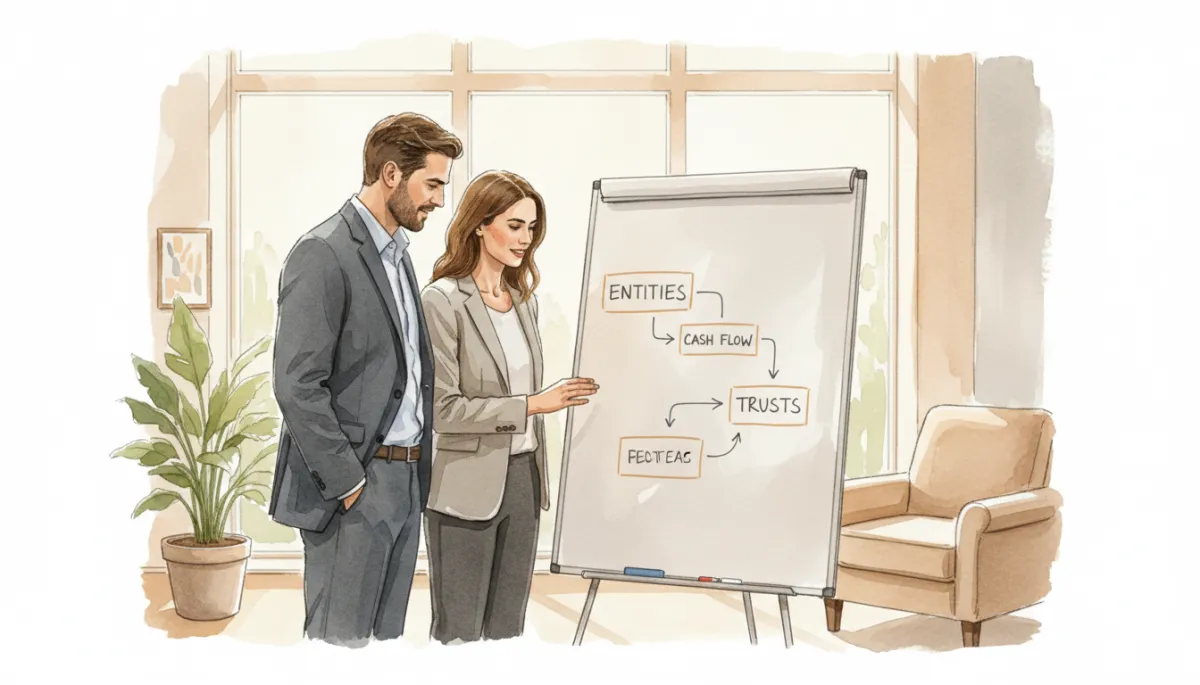
-toned photograph of a business owner and advisor standing over a simple whiteboard diagram...
Clear structure turns scattered accounts and entities into an intentional wealth system.
A Practical Business Example of Structure
Consider two entrepreneurs with similar incomes. Both own service businesses generating healthy cash flow. The first has everything in one place: personal and business expenses blended, no clear separation of accounts, no formal compensation structure, and minimal documentation. Taxes are a yearly surprise. Lawsuits are a constant fear. Every new strategy feels like another spinning plate to manage.
The second entrepreneur has taken time to design structure before chasing strategy. The business is properly formed and maintained. There is a clear flow: revenue into the business, compensation out in a defined way, reserves set aside, taxes planned throughout the year, and personal wealth built in separate, protected entities. They still face risk and uncertainty everyone does, but their system is designed to absorb shocks instead of collapsing under them.
“Structure before strategy: a wise plan needs a strong frame to stand on.”
Compliance, Education, and Sovereignty
Many professionals see compliance tax rules, entity requirements, record-keeping as a burden. But from a sovereignty perspective, compliance is part of your defense system. It protects what you’ve built and keeps your structures legitimate in the eyes of the law. It’s not glamorous, but neither are the foundations of a bridge. They just quietly keep everything from falling into the river.
Education is the other side of that coin. You don’t need to become your own attorney or accountant, but you do need enough understanding to ask good questions, recognize red flags, and make aligned decisions. At BDE Wealth, we often say, “Systems over shortcuts.” Quick tricks might feel exciting, but structured understanding gives you staying power. That’s where true financial sovereignty begins when you’re no longer guessing, but intentionally directing your wealth.
Reflective Questions
If someone asked you to sketch how money flows through your life and business, could you draw it clearly on one page?
Where are you relying on “hope and hustle” instead of documented structure and intentional design?
Practical Takeaway: Schedule time to map your current structure. Identify your entities, accounts, income sources, and major expenses. Even a rough diagram will reveal gaps and opportunities to strengthen your financial sovereignty.
Intentional Wealth Design: Purpose Over Possessions
Wealth without intention often leads to lifestyle drift: more income, more expenses, more complexity, but not necessarily more meaning. Intentional wealth design flips that script. Instead of asking, “What can I afford?” you ask, “What am I building, and why?” It’s the difference between filling a storage unit with random furniture and designing a home where every room has a purpose and every piece has a place.
Historically, some of the most enduring families and institutions approached wealth as a long-term design project, not a short-term scoreboard. They invested in land, education, businesses, and community infrastructure with timelines measured in decades, not quarters. They created charters, trusts, and governance structures that reflected their values. They asked not just, “What do we want now?” but “What do we want to exist 50 or 100 years from now because of the choices we make today?”
“Purpose over possessions: wealth is most powerful when it serves a clear mission.”
A Modern, Relatable Example
Imagine a professional couple in their 40s with two careers, growing income, busy family life. For years, their main financial goal was “earn more.” As income rose, so did their home size, vehicles, and travel. Nothing extravagant, just incremental upgrades. But one day they realized something sobering: despite making more than ever, they felt less free. Their calendar was full, their obligations heavy, and their savings scattered. They had many possessions, but no unifying purpose behind them.
Working with an advisor, they stepped back and asked deeper questions. What did they want their children to remember about this season of life? What impact did they want to have on their community? How much was “enough” for lifestyle, and what would they do with the surplus if they defined it clearly? Over time, they redesigned their spending, simplified their accounts, clarified their giving, and created a long-term plan for both business interests and eventual inheritance. Their net worth continued to grow, but more importantly, their sense of alignment did too.
Reflective Questions
If your current financial path continued unchanged for the next 10 years, what kind of life and legacy would it create?
Which parts of your spending, saving, or investing feel intentional and which feel like habits you’ve never fully questioned?
Practical Takeaway: Write a short “Wealth Purpose Statement” for yourself or your family. Include what you want money to make possible in terms of time, relationships, impact, and legacy. Revisit it before major financial decisions.
Family Governance and Long-Term Legacy: Teaching the Next Stewards
Many professionals work hard so their children “won’t have to struggle as we did.” The heart behind that is generous, but without wisdom, it can unintentionally create entitlement, confusion, or conflict. Long-term legacy is not just about leaving assets. It’s about preparing the next stewards emotionally, relationally, and practically to handle what they will one day receive.
This is where family governance enters the picture. Governance is simply the way decisions are made and communicated. It can be formal, like a family constitution or a board meeting, or informal, like regular conversations around the dinner table. Either way, governance answers questions such as: How do we make financial decisions as a family? What values guide our choices? How do we handle disagreements? What expectations do we have for those who benefit from the family’s wealth?
A Simple Story of Governance in Action
One family we’ll call the Thompsons decided that instead of waiting for a “reading of the will” someday, they would begin practicing legacy now. Once a quarter, they held a short “family finance meeting.” At first, it was just the parents, talking through goals and reviewing their giving. As their children became teenagers, they invited them to join part of the conversation. They shared what they were saving for, how they thought about giving, and why they had chosen certain insurance and estate planning tools—not in technical detail, but in plain language tied to their values.
Over time, the children began to ask thoughtful questions. They learned that wealth wasn’t a secret pile of money to be discovered someday, but a set of responsibilities being practiced in real time. When the parents later created a trust and basic governance guidelines, the documents weren’t a surprise. They were a natural extension of conversations already happening. The Thompsons weren’t just transferring assets; they were transferring wisdom, expectations, and a framework for decision-making.
“Legacy is less about what you leave to your family and more about what you leave in them.”
Reflective Questions
If you were gone tomorrow, would your family understand not only what you left them, but why you structured things the way you did?
What small, regular conversations could you begin now to normalize talking about money, values, and responsibility at home?
Practical Takeaway: Choose one topic saving, giving, or a family goal and start a short, age-appropriate conversation with your spouse, children, or heirs. Over time, these small conversations become the foundation of your family governance.
Challenging Common Assumptions About Wealth
As professionals, business owners, and legacy-minded individuals, we are surrounded by messages about money: social media, news headlines, even casual conversations. Many of these messages are rooted in assumptions that don’t hold up under real-world scrutiny. To pursue true financial sovereignty, we have to gently but firmly question them.
Assumption 1: “More income will solve my stress.” In reality, without stewardship, structure, and intentional design, higher income often brings higher complexity. Stress declines when clarity and systems improve, not just when numbers grow.
Assumption 2: “If I pick the right investment, everything will be fine.” Investments matter, but they’re one piece of a larger ecosystem. A great investment in a poor structure can still lead to unnecessary taxes, risk, or family conflict.
Assumption 3: “Talking about money with family causes problems.” Avoiding money conversations doesn’t prevent problems; it usually postpones and multiplies them. Thoughtful, guided discussions can actually reduce conflict and build trust.
“Silence is not a strategy. Confusion is not a plan. Hope is not a system.”
Practical Takeaway: Notice one money assumption you’ve carried for years. Ask yourself: “Is this actually true in my experience? Does it hold up when I look at families and businesses I respect?” Let your observations, not the noise, guide your next steps.
Wisdom, Not Just Wealth: From Temporary Possession to Lasting Legacy
When we zoom out, history offers a humbling perspective. Fortunes have been built in shipping, railroads, oil, technology, and real estate. Some disappeared within a generation. Others evolved, adapted, and continued to shape communities and families for decades. The difference rarely comes down to the original amount of money. It comes down to the wisdom with which that money was managed, taught, and transferred.
Money can be earned through your work, your ideas, and your persistence. It can be inherited from those who came before you. It can be spent on experiences, possessions, and opportunities. But wisdom determines what happens next. Does that money become a brief chapter of comfort, or does it become part of a larger story a story of stewardship, structure, sovereignty, and intentional design that outlives you?
At BDE Wealth, our conviction is simple: wealth without wisdom is fragile. It may look impressive from the outside, but it is vulnerable to poor decisions, external shocks, and internal conflict. Wisdom doesn’t eliminate risk or guarantee outcomes, but it dramatically changes your odds of building something that lasts and of living with more peace in the process.
“Money can open doors. Wisdom decides which ones you walk through.”
Your Next Step: Join The Sovereignty Circle™
If this perspective resonates with you, if you sense that your next level of wealth is less about chasing the latest tactic and more about deepening your understanding, then your next step isn’t a product. It’s education, community, and structure. That’s exactly why we created The Sovereignty Circle™ at BDE Wealth.
The Sovereignty Circle™ is designed for individuals, families, and business owners who want to move from confusion to clarity and from reaction to intentional design. Inside, we explore stewardship, structure, tax awareness, risk, business ownership, and legacy planning through calm, educational conversations, not hype. You’ll learn frameworks, not fads. You’ll gain language to talk with your advisors and your family. And you’ll be surrounded by others who value purpose over possessions and systems over shortcuts.
Final Reflection
As you consider your own path, pause for a moment and ask yourself:
Am I pursuing more money, or greater wisdom about the money I already have?
If my wealth story were a book, what kind of ending would I want my children or my community to read?
Money will come and go in many forms: salary, business revenue, real estate, investments, inheritances, and expenses. It can be earned, inherited, or spent. But wisdom is what turns those dollars into decisions, those decisions into systems, and those systems into a story that lasts beyond your lifetime. That is the purpose of wealth: not simply to have more, but to steward more wisely, to structure more intentionally, and to live and lead with sovereignty.
If you’re ready to deepen your understanding and design a legacy with intention, we invite you to take the next step in your education. Explore The Sovereignty Circle™ and begin building not just wealth, but the wisdom to sustain it for generations.