
Why Tax Strategy Matters More Than Tax Preparation
Taxes, Financial Stewardship, Wealth Design, BDE Wealth
Why Tax Strategy Matters More Than Tax Preparation
Taxes are not just a once-a-year paperwork chore. They are a mirror, quietly reflecting the financial decisions you made all year long. At BDE Wealth, we believe that understanding this difference is one of the most important steps toward true financial stewardship and sovereignty. In this article, we’ll explore why tax strategy matters more than tax preparation, and how planning can support your cash flow, compliance, and long-term wealth design.
Why Before How: The Heart Behind Tax Strategy
Most people start with the question, “How do I pay less in taxes?” That’s understandable, but it skips an essential step. At BDE Wealth, we start with a different question: Why does tax strategy matter in the first place? When you understand the “why,” the “how” becomes clearer, calmer, and far less stressful.
Think of your financial life as a house. Tax preparation is like documenting what was built last year: the rooms you added, the repairs you made, the materials you used. It’s a report. Tax strategy, on the other hand, is the architectural blueprint. It’s the thought that goes into where the walls should go, how the foundation is poured, and what kind of structure you’re designing for the next 10, 20, or 40 years. One reports what exists; the other shapes what will exist.
When you only focus on tax preparation, you’re always looking backward. You ask, “What happened last year, and how do we report it?” When you embrace tax strategy, you ask, “What kind of life, business, and legacy am I building, and how can the tax code support that design?” That shift from fear and reaction to stewardship and intention is where real financial sovereignty begins.
“Tax strategy is not about beating the system; it’s about learning the rules so you can play your role as a wise steward.”
Reflective Questions: Clarifying Your Why
When you think about taxes, do you feel reactive and rushed, or calm and prepared?
Are your financial decisions driven more by short-term refunds or long-term freedom?
If your tax return is a mirror, what story is it telling about your priorities?
📌 Practical Takeaway: Before you look for deductions or credits, take 10 minutes to write down why you care about building long-term wealth—family, freedom, impact, legacy. Let that “why” guide every financial and tax decision you make this year.
Tax Preparation vs. Tax Strategy: Two Different Tools, Two Different Purposes
A common assumption is that if you “have someone who does your taxes,” you’re covered. But “doing your taxes” usually means tax preparation, not tax strategy. These two services are related, but they are not the same, and expecting one to do the work of the other often leads to disappointment, surprise tax bills, or missed opportunities.
What Tax Preparation Really Does
Tax preparation is the process of gathering your documents W-2s, 1099s, business reports, investment statements and accurately reporting them to the IRS and your state. It answers questions like:
What income did you earn last year?
What deductions and credits do you qualify for based on what already happened?
What is your final tax due or refund for that closed year?
Good tax preparers are essential. They help you stay compliant, avoid unnecessary penalties, and file accurately. At BDE Wealth, we view tax preparation as a non‑negotiable part of good stewardship. But preparation is a rearview mirror. It cannot change the road you already drove.
What Tax Strategy Really Does
Tax strategy, by contrast, is about the decisions you make before the year is over. It looks ahead and asks:
How should your business or investments be structured to support both compliance and cash flow?
When does it make sense to shift income, accelerate expenses, or leverage retirement and education accounts?
How can you align your giving, investing, and business activities with the tax code in a way that honors your values and long‑term goals?
If tax preparation is the historian, tax strategy is the architect and project manager. One records what happened. The other helps you decide what happens next.
“Tax preparation reports the past. Tax strategy shapes the future.”
Reflective Questions: Are You Expecting the Wrong Thing?
Have you ever been frustrated with your tax preparer for not “saving you more,” even though you only met with them once a year?
Do you know what actual tax strategies are being used in your situation, or are you assuming they’re happening behind the scenes?
If someone asked you to explain your tax strategy in two or three sentences, could you?
📌 Practical Takeaway: Clarify with your current tax professional whether they provide strategy or only preparation. Ask, “When during the year do we proactively review my situation and make planning decisions?” If the answer is “we don’t,” you’ve identified a gap.
Tax Strategy Begins Long Before Tax Season
Many people treat tax season like a yearly emergency. The calendar flips to January, and suddenly there’s a rush to collect documents, search for receipts, and hope for the best. But by the time you’re in “tax season,” most of your options for that year are already closed. The tax return is simply the scoreboard for a game you finished playing months ago.
Effective tax strategy begins in January, not in March or April. It begins when you:
Decide how to structure a new business or side venture.
Choose how much to contribute to retirement or health savings accounts.
Plan for major purchases, real estate moves, or large charitable gifts.
Imagine you’re a business owner who waits until March to discover that you had a significant profit last year, but you never adjusted estimated taxes, never invested in needed equipment, and never set up a retirement plan. At that point, your preparer can only report what happened. With a strategy conversation in June, September, or November, you could have made decisions that eased the tax burden, improved cash flow, and aligned with your long‑term goals.
“You don’t rise to the level of your tax refund; you fall to the level of your planning.”
Reflective Questions: Your Timeline for Decisions
When during the year do you typically think about taxes: only when forms arrive, or throughout the year as you make decisions?
Have you ever delayed a financial decision because you weren’t sure of the tax impact, and then simply did nothing?
What would change if you had a mid‑year and year‑end tax strategy review built into your calendar?
📌 Practical Takeaway: Add two recurring appointments to your calendar right now: a “Mid‑Year Tax Strategy Check‑In” and a “Year‑End Planning Review.” Even if you don’t yet have a tax advisor, reserve that time for reviewing your income, expenses, and upcoming decisions so you can approach them intentionally.
How Tax Strategy Influences Financial Decisions All Year Long
One of the biggest misconceptions we see at BDE Wealth is the belief that taxes are a separate topic from everyday financial life. In reality, tax strategy quietly sits underneath almost every major decision: how you earn, how you spend, how you give, and how you invest. The goal is not to let taxes drive every choice, but to let them inform your choices so you can act with clarity instead of confusion.
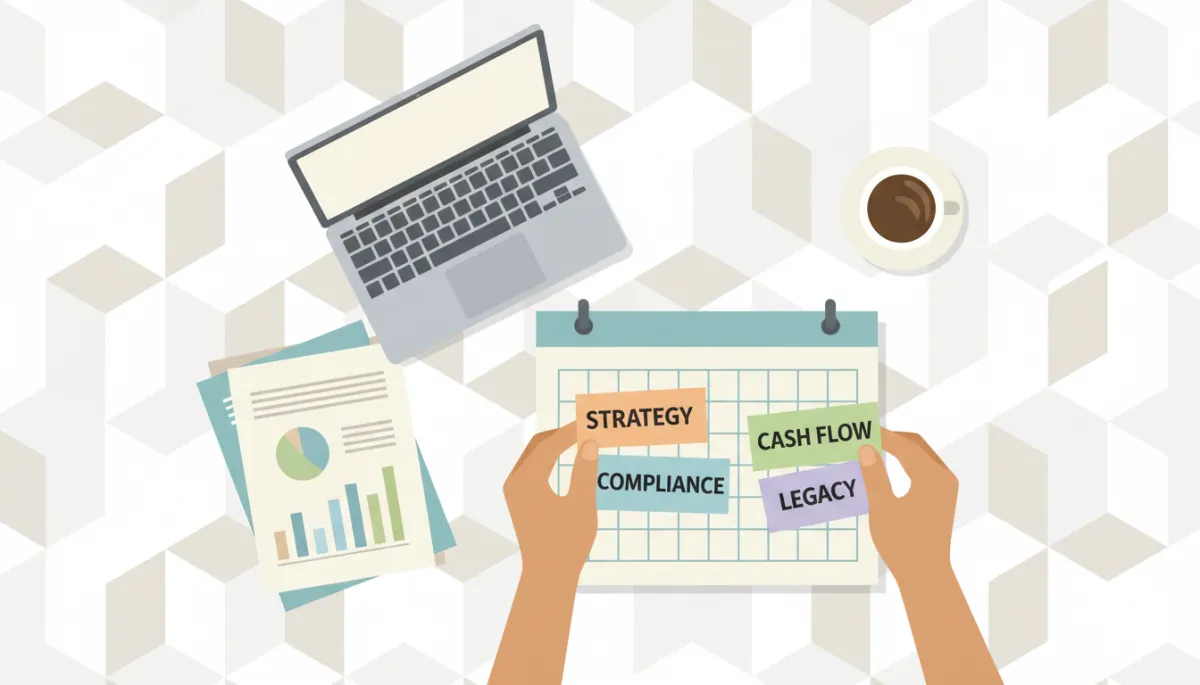
-toned overhead view of a desk with a calendar, financial reports, a laptop, and a cup of...
Aligning everyday decisions with a clear tax strategy turns scattered actions into a cohesive plan.
Everyday Example: The Side Business Decision
Consider someone who starts a side business consulting, online sales, or real estate. Without strategy, they may mix personal and business expenses, use the wrong bank accounts, and ignore quarterly taxes. At year‑end, they’re surprised by both the profit and the tax bill, and the tax return becomes messy, stressful, and possibly risky from a compliance standpoint.
With strategy, that same person:
Chooses a structure (sole proprietor, LLC, S‑Corp, etc.) that fits their goals and stage of growth.
Opens dedicated accounts and tracks income and expenses cleanly throughout the year.
Sets aside money monthly for taxes, so there are no surprises in April.
The difference is not just in the final tax number. It’s in the sense of control, clarity, and confidence they experience all year long.
Everyday Example: The Family Cash Flow Decision
Another example: a family deciding whether to increase retirement contributions, fund a Health Savings Account, or pay down debt. Without strategy, these choices might be random or based on whatever article they read last. With strategy, they look at:
Current and projected income for the year.
Available tax‑advantaged accounts and limits.
Their long‑term goals: college, retirement, business ownership, or early work optionality.
The result is not just “saving on taxes.” It’s aligning today’s dollars with tomorrow’s priorities in a way that respects both stewardship and sovereignty.
“Every financial decision has a tax consequence. Strategy is choosing those consequences on purpose.”
Reflective Questions: Daily Decisions, Long-Term Impact
Which of your current decisions business, career, or family might have tax implications you haven’t fully considered?
Are your accounts and structures (LLCs, trusts, retirement plans) aligned with how you actually live and work today?
If nothing changed in your approach to taxes for the next 10 years, would you be content with the outcome?
📌 Practical Takeaway: Choose one area your job, your business, your investments, or your giving and list the main decisions you expect to make this year. Next to each, write, “What is the tax impact?” If you’re not sure, that’s a signal to seek guidance before, not after you act.
Tax Strategy as a Tool for Compliance, Cash Flow, Stewardship, and Long-Term Wealth
At BDE Wealth, we don’t view tax strategy as a game of “how little can I pay?” That mindset often leads to shortcuts, aggressive positions, and anxiety. Instead, we view tax strategy as a tool to support four key pillars of a healthy financial life: compliance, cash flow, stewardship, and long‑term wealth.
1. Compliance: Protecting Your Peace of Mind
True sovereignty doesn’t come from ignoring the rules; it comes from understanding them. A good tax strategy keeps you within the law while using the provisions available to you. That means:
Filing accurate returns that reflect your real activity and structures.
Keeping clean records that support your positions if questions arise.
Avoiding schemes or shortcuts that promise extreme savings at the cost of integrity or legal risk.
Compliance isn’t the enemy of strategy; it’s the foundation. When you know your approach is honest and well‑documented, you free mental space to focus on building, not worrying.
2. Cash Flow: Keeping More of What You Earn, When You Need It
Taxes affect not just how much you pay, but when you pay it. Strategy can help you smooth cash flow so you’re not constantly surprised by large bills or overpaying throughout the year. Examples include:
Planning estimated payments for business owners and investors so taxes are built into your rhythm, not emergencies.
Using tax‑advantaged accounts strategically to defer or reduce taxes while still meeting near‑term needs.
Aligning major purchases or investments with your income cycles and tax brackets.
3. Stewardship: Aligning Taxes with Your Values
Stewardship means managing what you’ve been given with wisdom and intention. Tax strategy can actually express your values, whether that’s generosity, family support, business building, or community impact. For example:
Structuring charitable giving in ways that maximize both impact and deduction, such as donor‑advised funds or appreciated asset gifts.
Compensating family members who legitimately work in a family business, teaching responsibility while shifting income to lower brackets.
Using business structures that protect your ability to serve clients and employees for the long term.
4. Long-Term Wealth: Designing for Decades, Not Just This Year
Finally, tax strategy plays a crucial role in how wealth is built, preserved, and transferred. Decisions about retirement accounts, real estate, business ownership, and estate planning all carry tax consequences that can either support or erode your long‑term vision. A strategy rooted in intentional design will consider:
How today’s tax savings affect tomorrow’s tax brackets and flexibility.
How to pass assets to the next generation in ways that minimize unnecessary tax friction.
How to balance tax deferral with liquidity and lifestyle goals.
“Wealth is not just what you earn; it’s what you intentionally design, protect, and pass on.”
Reflective Questions: The Four Pillars in Your Life
Where do you feel least confident right now: compliance, cash flow, stewardship, or long‑term wealth design?
Have any past decisions created tax stress that could have been avoided with earlier planning?
Which pillar, if strengthened over the next year, would bring you the most peace?
📌 Practical Takeaway: Choose one pillar compliance, cash flow, stewardship, or long‑term wealth and write a single, specific question you want answered about it. Bring that question into your next financial or tax conversation so your planning moves from general to intentional.
Challenging Common Assumptions About Taxes and Strategy
To build a healthier relationship with taxes, we have to challenge some of the common assumptions that quietly shape our decisions. Here are a few we see often at BDE Wealth and how a stewardship‑based perspective reframes them.
Assumption 1: “Taxes are the enemy.” When we view taxes as the enemy, we tend to avoid the topic until we’re forced to face it. This leads to rushed decisions, fear, and sometimes risky choices. A healthier view: taxes are a reflection of decisions made. They are data, not a verdict on your worth. When you see them as feedback, you can adjust your design rather than resent the mirror.
Assumption 2: “A big refund means I did well.” A large refund often means you gave the government an interest‑free loan. It can feel good, but it’s not always a sign of smart planning. Strategy asks, “How can I align my withholdings and estimates so my cash flow supports my goals throughout the year?”
Assumption 3: “My CPA handles everything.” Many preparers are excellent at compliance but are not engaged for ongoing strategy unless you specifically request it. Delegating does not remove your responsibility. True sovereignty means understanding enough to ask better questions and partner in the process.
“Taxes are not a judgment; they are a report card on how your structures and decisions interacted with the law.”
Reflective Questions: Which Assumptions Are Driving You?
When you receive your tax return, do you analyze what it’s telling you, or do you simply file it away and move on?
Are you more focused on the size of your refund than on whether your year‑round decisions matched your values and goals?
What would change if you saw your tax return as a tool for learning, not just a form to sign?
📌 Practical Takeaway: Pull out last year’s tax return and, instead of skimming, ask: “What is this telling me about how I earned, spent, gave, and invested?” Write down three observations and one change you’d like to see reflected next year.
Taxes as a Reflection of Intentional Wealth Design
At its core, the BDE Wealth philosophy is about intentional design. Wealth is not just a number in an account; it is the sum of your time, relationships, knowledge, character, and impact. Taxes intersect with all of these. They reveal how you’ve structured your work, your businesses, your investments, and your giving. Over time, they show patterns of either reaction or intention.
When you engage in tax strategy, you are not just trying to “win” this year. You are designing a system that can serve you for years to come. You’re choosing structures that support your family, your calling, and your legacy. You’re aligning your financial life with your deepest values, rather than drifting from one tax season to the next.
“Intentional wealth design turns your tax return from a surprise into a story you recognize because you wrote it on purpose.”
📌 Practical Takeaway: Decide on one “storyline” you want your tax return to tell three years from now, perhaps “We transitioned to business ownership,” “We became consistent givers,” or “We built strong retirement foundations.” Let that storyline guide the strategic steps you take each year.
Bringing It All Together: Preparation and Strategy in Financial Stewardship
Tax preparation and tax strategy are not competitors; they are partners. You need both. Preparation keeps you honest, accurate, and compliant. Strategy keeps you intentional, proactive, and aligned with your long‑term vision. When they work together, tax season becomes less about fear and more about feedback. You stop asking, “What happened to me?” and start asking, “How did my decisions perform, and what will I design next?”
At BDE Wealth, we see taxes as one of the clearest reflections of stewardship. They show whether your structures match your reality, whether your habits match your priorities, and whether your planning matches your desired legacy. Taxes are not the enemy. They are a powerful lens through which to view your financial life and, with the right strategy, they can become a supportive part of your journey toward sovereignty and long‑term impact.
“When you steward your decisions, your taxes stop surprising you. They start affirming the structure you’ve built.”
Your Next Step: Schedule a Tax Advisory Strategy Session
If you’ve been relying only on tax preparation, you’re not alone. Most people were never taught the difference, and the financial world often focuses on quick fixes instead of systems. But you don’t have to stay in a reactive cycle. You can choose to design your financial life with intention, structure, and clarity.
A Tax Advisory Strategy Session with Tax Deivas LLC is an opportunity to step back from the rush of forms and deadlines and ask deeper questions:
What is my current tax picture really telling me about my structures and decisions?
Where are the gaps between how I’m living and how I want to design my financial life?
What specific steps can I take this year to move from reaction to intentional strategy?
Our goal is not to overwhelm you with jargon or push aggressive tactics. Our goal is to educate, clarify, and help you build a framework you can understand and sustain. If you’re ready to view taxes not as a yearly burden, but as a key part of your stewardship and legacy journey, we invite you to take the next step.
📌 Invitation: Schedule a Tax Advisory Strategy Session with Tax Deivas LLC to begin aligning your tax decisions with your values, your structures with your goals, and your financial life with the legacy you want to create. This is not about shortcuts; it’s about systems, education, and intentional design so you can move from confusion to clarity and from reaction to true financial sovereignty.
Professional Services Disclosure
BDE Wealth has partnered with Tax Deivas LLC to provide professional tax advisory, tax preparation, and tax compliance services for clients who require implementation beyond the educational resources provided through The Sovereignty Ledger™.
BDE Wealth serves as an educational platform focused on financial stewardship, financial sovereignty, business structure, and intentional wealth design. The information presented in this article is intended solely for educational purposes and should not be interpreted as individualized tax, legal, accounting, financial, or investment advice.
Professional tax services referenced in this article are provided through Tax Deivas LLC, where I proudly serve as Director of Operations. Every taxpayer's circumstances are unique, and recommendations should always be based on your individual facts, goals, and applicable tax laws.
If you're ready to move from education to implementation, we invite you to schedule a Tax Advisory Strategy Session with Tax Deivas LLC.