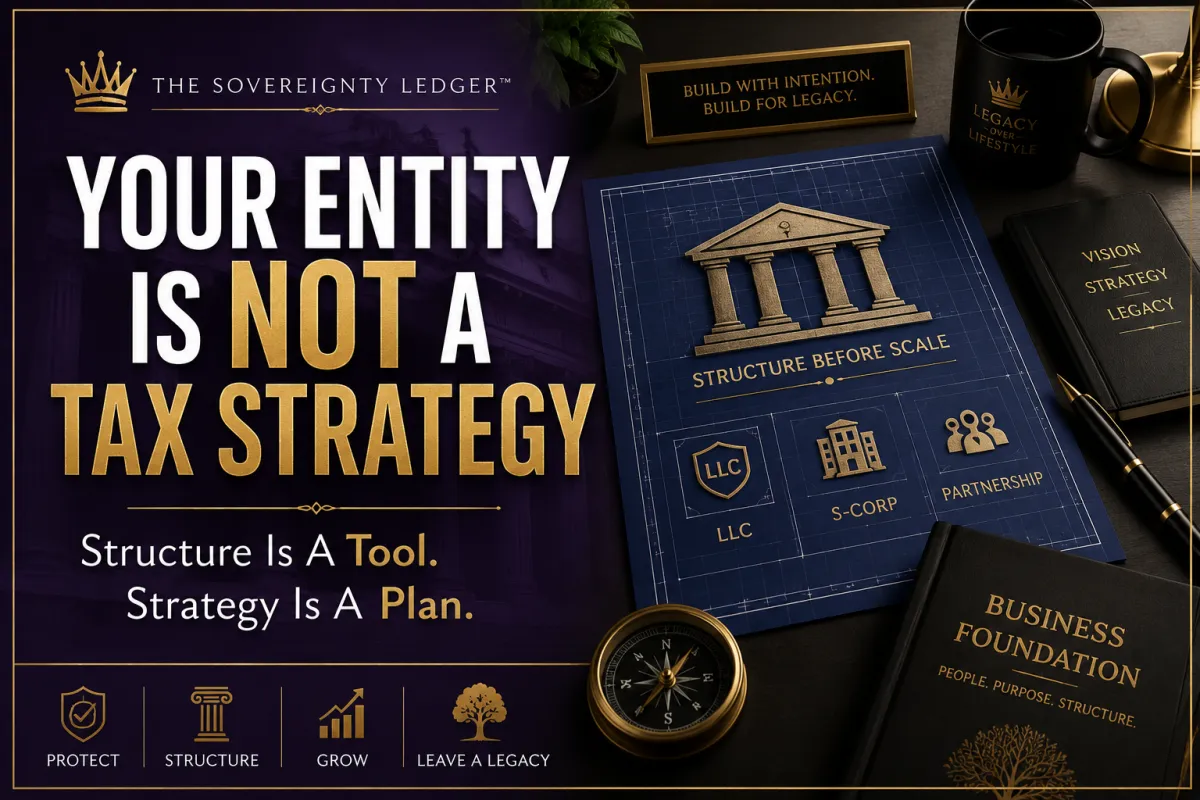
Why Your Entity Is Not a Tax Strategy
Many business owners hear phrases like:
"You need an LLC."
"You should become an S-Corporation."
"A corporation will save you taxes."
While these statements may contain some truth, they often create confusion because they mix two different concepts: business structure and tax strategy.
Understanding the difference can help business owners make better decisions and avoid costly mistakes.
What Is An Entity?
An entity is simply a legal structure used to organize ownership and operations.
Common examples include:
Sole Proprietorship
Limited Liability Company (LLC)
Partnership
Corporation
S-Corporation Election
An entity creates a framework for how a business operates.
It does not automatically create a strategy.
The Most Common Misunderstanding
One of the biggest misconceptions among business owners is believing that forming an LLC automatically lowers taxes or creates protection.
An LLC is a tool.
Just like a hammer does not build a house by itself, an entity does not create results by itself.
Without proper management, documentation, planning, and execution, an entity is simply paperwork.
Structure Before Scale
Many entrepreneurs spend more time chasing structures than building systems.
Before creating multiple entities, business owners should understand:
Cash Flow
Recordkeeping
Tax Compliance
Risk Management
Business Operations
Structure should support growth.
Structure should not become a distraction from growth.
What A Tax Strategy Actually Is
A tax strategy is an intentional plan designed to help achieve specific goals.
A true strategy considers:
Business objectives
Tax implications
Risk exposure
Ownership structure
Long-term plans
The entity may be part of the strategy, but the entity itself is not the strategy.
Asking Better Questions
Instead of asking:
"What entity should I form?"
Consider asking:
What am I trying to accomplish?
What risks am I trying to manage?
What tax considerations should I understand?
What does success look like five years from now?
Clear goals often lead to clearer structural decisions.
Final Thoughts
Many business owners focus on selecting the right entity before they understand the purpose behind it.
The better approach is to understand the destination first.
An entity is a tool.
A strategy is a plan.
Knowing the difference is one of the first steps toward building a stronger business foundation and making more informed decisions.
👑 Structure Before Scale.
🌱 Stewardship Before Complexity.
💎 Strategy Before Implementation.